Bring a massive star to 0.3 pc.
Drag a black hole’s path across the cloud.
Drag a big moon of a giant inside its Roche limit.
Take turbulence out of the cloud core.
Flick a body the giants’ shift scattered into orbit round a gas giant, against its spin.
Squeeze the cloud core to 0.70 of its size.
Drop an icy moonlet on the world you are viewing.
Pour 0.1 Sols of the outer gas onto the cloud core.
Heat this world’s mantle.
Hurl a 500 km asteroid at this world.
Hurl one of the system’s young planets into another; hold for how heavy.
Hurl one of the system’s young planets into an ice giant; hold for how heavy.
Drag on the cloud to move its gas.
An object from another star passes through.
Two neutron stars merge nearby.
Drag a world’s orbit into its star.
Hold two planets at 2:1 or 3:2, or 60° apart on one orbit.
Make a nearby star explode; hold for how close.
Shift the giants, or push the outer one farther out.
Flare the young star a hundredfold; hold for how long.
Pour gas from the envelope onto the outer disk; hold for how much.
A star passes 150 AU away.
Knead the world you are viewing harder in its tides.
Raise a ring where you tap the disk.
A dying star’s dust drifts in.
Send a sunless planet through the system; hold for how heavy.
Seed a 10-Earth core beyond the ice line.
Add icy dust beyond the ice line.
Draw a carbon star’s soot into the cloud.
Send in comets from the icy belt.
Dim the outside light on the cloud core.
Send a blast wave at the cloud core; hold for strength.
Let the field carry spin out of the cloud core.
Hold to drag this world's day backwards.
Spin the cloud core up.
Another star passes the edge of the system and shakes comets loose.
Stir the disk’s gas.
Churn the cloud core’s gas.
Turn the young star’s X-rays on a world still wrapped in hydrogen.
The star throws a giant flare at its worlds.
Add gas and dust where you tap the disk.
Swing a far star's orbit over until it starts stretching the planets' orbits.
Drag the companion's orbital plane: the disk beyond the break heels over with it.
Open twin jets along the axis.
Added phosphorus.
A tidally locked world’s night side freezes its air out: an atmospheric collapse on an eyeball world.
Bind the pair.
Broke the lock.
Caught the streamer and turned it with the spin.
Caught the planet.
Deflected the impactor.
The young star’s light and wind blow the disk’s gas away from the inside out, and the planets are left in the open.
More gas through its gap makes a bigger giant that shields more, scatters harder and clears sooner.
Chemistry on a world becomes alive for the first time.
The orbits settle after the last collision; the worlds’ clocks start.
Flared the star.
Gathered a moon.
A shield over a world’s first life: for a billion years a sterilising impact misses it.
Make a core growing at a now.
The cloud core’s centre grows hot enough to fuse hydrogen and the star’s light breaks out across the cloud.
Moved a giant.
Set how hard ’s gas drags a young world toward its star.
Shade the disk.
Sheltered deep life.
Less gas at its orbit makes a smaller giant that drifts less and leaves gas and ice for the rest.
The run’s last stage closes: the system at rest (The Present), its star’s death (The Long Dusk) or an early silence (Silence), and what became of each world.
Young worlds were hit far more often than today; now and then a comet storm made it twenty times worse.
A hard blue-white flash on one side of the sky; heavy-element glitter drifts in and settles into the cloud core.
A bridge of gas is drawn off the cloud core toward a heavier neighbour, a tail thinning behind it.
The fleeing planet swings back in and settles onto a wide, stretched orbit.
A hot shell closes on the cloud core and the cloud core brightens; cool gas falls in after it.
A swarm of comets falls in from the icy belt, tails streaming, and flashes on the inner planets.
A dark coat of dust closes round the cloud core and the outside light dims.
A dark body crosses the cloud, its rim lit, dragging a bright wake of squeezed gas.
Dust rises from the edge on the star’s side into a dark band, and the glare thins behind it.
The world slows, stops and turns the other way. Its magnetic field fades and a thin wake of air leaves the limb.
The outer disk leans over to the angle you chose, and the star’s shadow lays two cold bands across it where ice glints.
A far star’s plane swings over, and the planets’ orbits begin to breathe.
A faint magnetic field rises round the world and holds.
The young star flashes blue-white and a hot wind lifts off the disk’s surface.
The hot debris ring round the planet spirals together into one glowing moon.
The flash fills the sky; a disk of debris spreads and cools from white to orange, and a moon may gather from it.
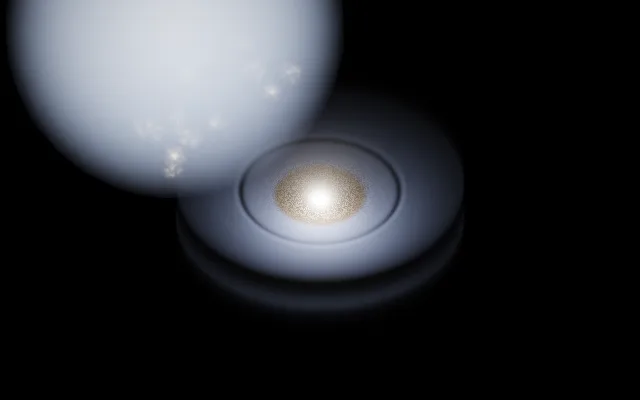
A young planet strikes an ice giant over its pole. The giant rolls onto its side, and its moons’ orbits swing with it.
A star flares off the world’s limb, brighter than its moon; its light washes over the face and the ozone thins to a pale shimmer.
The world squeezes toward its host and back; cracks glow on its shell and plumes rise where the heat leaks out.
A lane of warm gas streams along your stroke through the cloud core, then a cool wave answers.
The cloud core’s rim lights on its neighbours’ side and its gas peels off.
An orange haze thickens over the world as its first life breathes out methane, and the ice retreats.
The giant glides from its old orbit to its new one, and the old orbit fades.
A star, or a black hole, crosses the starfield; comets fall on every world as lit streaks.
A star swings by. The outer gas and dust shear into a stream, and a few bodies glint far out.
The planet glides from its old orbit to a slightly wider one, and the old orbit fades.
A puff of warm gas and dust swells where you tapped.
A bright ring of dust piles at the bump and the gap inside it darkens.
A dark, sunless planet crosses the field, lit only by the star; the orbits ripple after it.
A core glows into place at its orbit and its gap opens.
The filaments round the cloud core re-seat as the gas moves from the old setting to the new; the cloud shows what it is.
The gas’s churn slows and settles into a cool haze.
A blast from a star that exploded nearby sweeps in as a bright shell; the cloud core flares.
A bright, dense shell sweeps in, lighting the knots it passes, and the cloud core flares.
A slow, sooty flow drifts in over the cloud core and the cloud core reddens.
Warm sparks sink from the burning surface along the cracks into the crust, and one glows deep in the rock.
Gas falling in from the side swings round into the cloud core’s spin and falls in; the disk-to-be keeps its plane.
A tongue of light arcs off the star. A world with a magnetic field lights an aurora at both poles; a world without one streams its air off as a lit wake.
The incoming body flashes as it is nudged and bends its track past the world.
A small icy body crosses with its tail, is caught and breaks into the disk.
The gas wheels round the cloud core, wider and faster when it spins up.
A world swings into its star’s light and is lost.
A world spirals into its star, which flares white a thousandfold and lights the whole system; a dust shell swells and dims the inner worlds.
A 500 km asteroid falls, strikes in a bright flash and throws up a plume of hot rock vapour. A graze turns the day backwards as it strikes.
An icy moonlet falls trailing a coma, strikes in a flash and throws up a plume of steam.
A dense, cool stream spirals in and falls on the cloud core, which swells and brightens.
A planet’s orbit stretches and eases, lit by its star, as a far star pulls.
The orbit leans in the star’s light and a sheet of ice advances from the poles toward the equator; the advanced ice stays.
The young star blooms a hundredfold; a heat front sweeps out with the ice line and the inner disk is left baked.
A body swings the wrong way round a gas giant and ploughs through its moons; each breaks in a flash, and the rubble glows as a disk round the giant.
The shallows along the world’s coasts cloud with minerals.
The young star’s light blows the last gas away; the planets are left in the open.
The setting stills; a living film spreads from the centre of the pools or the springs, holds at its widest, then pulses once in the setting’s light.
Each orbit’s last tremble damps, and the orbits close and lock, inner to outer; the habitable zone lights in the star’s own colour and the rocky worlds in it take their water’s colour.
Five swirls of gas turn through the cloud core, as wide as its turbulence.
Hot vents glow and flicker across the world’s face as its mantle heats.
The star’s brighter light swells on the world in its own colour, a pale haze rises over the seas and they dull under it.
Pale icy glitter settles beyond the ice line.
Two worlds settle onto one orbit lit by the star, sixty degrees apart, each a bright point in the other’s sky.
The night side darkens and the air frosts out across it; the day side’s sky thins and the frost stays.
Outside light floods one side and the edge’s gas peels outward.
The orange haze clears as oxygen destroys the methane, and white creeps in from the poles.
Thin seams of light trace the plate edges across the world, east to west; each plate takes a faint tint, and faint seams stay while the plates move.
A moon dragged inside its giant’s Roche limit stretches, tears and smears into a ring that brightens in the star’s light; the giant leans a few degrees.
Ripples run round the disk in three rings.
A dark, heavy stream of soot pours into the cloud and its knots dim.
The envelope’s gas pours onto the outer disk; spiral arms wind up and knots pinch off at their tips.
A world’s hydrogen haze lit by its star streams away in a tail and thins to bare rock.
The system eases to rest in the end page’s picture, or its star swells red and floods the inner worlds; then each world’s fate lights on it in turn, the living ones last.
A held breath, then the cloud core’s gas falls inward, its centre darkening as the dust piles up and the edge stars brightening through the thinning envelope.
The dull red core shrinks through a dark beat, then flashes in the star’s own colour; the jets open and the infalling gas lights.
More gas pours through the gap and onto the young giant; the gap darkens, then widens as the giant swells.
The gas at the giant’s orbit thins and drifts away; the gap stays dark and the giant stays smaller.
The first great comet storm falls on a young world: comets stream in, one large comet lands with a flash, and its crater’s glow cools from white-orange to dull red while the rain thins.
Twin bright jets open along the axis and cool cavities open at the poles.
The two cores swing round each other once and settle into their orbit.
The giants’ orbits waver against each other; pushed out, the outer giant’s orbit eases wider.
It is on course to hit in about …, enough to wipe out life on ….
A close pass with a giant flung it out between the stars, carrying … of water.
This … core now stops the dust drifting past it, cutting off the planets closer in.
This …-Earth core at … AU is still too light to stop the dust drifting past it.
Two near-equal worlds circling each other, each keeping one face to the other.
The giant’s core pulls in gas as fast as the disk can feed it, and drifts inward with the gas.
A massive star … pc away is boiling the disk’s outer gas and its ice toward … AU.
A heavier neighbour is pulling gas off this core, now … Sols, while the window is open.
The impact threw about …% of the impactor into a hot ring of debris, most of it falling back.
A nearby star has exploded: its blast reaches this core in … at strength ….
The star throws a giant flare, and a world with a magnetic field lights an aurora.
A world without a magnetic field loses air to the superflare, and keeps leaking.
It grows … the first giant, which circles at … AU.
Its gas moves too fast for its gravity to hold it (it holds together below …).
A giant impact blows off a share of a young world’s early atmosphere.
The star is heading for … Sols: bright, with a life of about ….
Comets shake loose and fall on every world.
The icy bodies the shift flings inward bring water to the inner worlds.
The disk’s edge is cut and the solids left far out.
Living chemistry has started in …, and one big enough impact can wipe it out.
A streamer of … Sols from the outer cloud is falling onto the cloud core, off its spin.
A … body has hit a young planet here, melting its surface and blasting off water.
The molten surface has crusted over under a thick sky of steam and CO₂, with … of water.
The whole surface is ice, and the ice reflects the sunlight that could melt it.
There is liquid water on the surface, with …% land, and life’s raw ingredients are fading.
Massive neighbours warm the gas to … K and this core must now exceed … Sols.
Beyond this line it is cold enough for ice, and solids pile up there while the rock inside stays dry.
…
Bodies the shift scattered strike the inner worlds far more often for 40 million years.
Its oceans are boiling into space, and at … AU nothing you can do stops it.
Spinning this fast, the collapsing core is breaking into two stars, and planets form only well outside them.
A … km … hit with …× the energy needed to boil the oceans.
The ozone is at …% of its column, and the sunlight sterilises the surface.
The field holds the cloud core up as it slips out, and above 1 gravity wins.
…'s tilt reaches …° and its ice edges toward the equator
Its heat flux is … mW/m² and falling.
The habitable zone’s inner edge is … AU away.
A star passes the disk.
Starlight has opened a gap and the gas is draining away from planets still gathering it.
At … AU the gas’s own gravity now beats its warmth (Q …, below 1 it breaks apart).
The far star stretches the orbit of the planet at … AU: its closest pass is now … AU.
… young planets remain, and from now on they grow by crashing into each other.
The giants move outward and fling the icy belt across the system, some of it as comets.
The star has brightened: the habitable zone’s inner edge is at … AU, … at … AU.
A world turns the other way, and its day runs long.
A co-orbital pair: one planet rides a Lagrange point, 60° ahead of the other.
The planet at … AU circles … times for every … of its inner neighbour.
The pair clears everything inside … AU, and the habitable zone sits at …–… AU.
Its carbide crust weathers slowly, so CO₂ swings far before the thermostat answers: … → … mbar.
A yellow-to-orange G or K star of 0.5 to 1.2 Sols, like Sol.
The actions you can take on this turn, each a physical intervention with a cost and a receipt. The word the game uses for its panel.
Rock the giant’s pull kept from gathering, a thin band inside its orbit holding 0.0004 Earths in ours.
The night side of a locked world grows cold enough that the air itself freezes out.
The Earth’s distance from Sol, about 150 million km.
Light at a world’s poles, where its magnetic field meets the star’s wind.
An orbit that goes round the other way from its star's spin.
Rock dust heated past about 430 °C, which loses the water bound in its minerals.
A spiral with a straight bar of stars through its middle, like the Milky Way.
A stellar-mass black hole crossing the cloud.
Drag a path across the cloud.
The shock from a nearby star exploding: it can squeeze the cloud or strip it.
A failed star, too light to burn hydrogen: it glows dull red and fades.
The opening chapter: where your cloud sits and what it is, before you shape it.
Set your cloud and Begin: a harder cloud gives more Power.
Sooty, carbon-rich rock that holds little water.
The dust’s carbon against its oxygen: above about 0.8, rock turns to carbide.
The habitable zone around a pair of stars: the band where a world circling both keeps liquid oceans.
The hole two stars sweep around themselves: nothing stays inside it.
Two planets sharing one orbit, one riding 60° ahead of the other.
Everything this run has met or offered: its powers, moments, effects, words, events and stages.
The odds the collapse has begun, building only while all three gates hold.
A shower of comets shaken loose onto every world.
Fast particles from the blast that keep the gas electric.
How long the gas takes to cross the cloud core: the stage’s own clock.
Dust dense enough to hide the stars behind it: a dark lane or patch on the sky.
A nursery packed with young stars, hundreds of them within a few light-years.
A star’s worth of cold gas knotted on a filament, dark enough to hide stars.
Solids a passing star cut from the disk’s edge and left far out, where comets come from.
A layer of diamond where a carbon-rich world's carbon sinks toward its core.
Two near-equal worlds circling each other, each keeping one face to the other.
Everything heavier than helium, made inside earlier stars and blown into the gas: what the disk builds planets from.
A shell of dust a star throws off as it swallows a planet, dimming its inner worlds for years.
A small galaxy of few stars, little dust and few nurseries.
A world big enough to be round but too small to clear its orbit, like Pluto and Eris.
Stars like Sol, swelling into red giants at the end and shedding carbon, nitrogen and half the heavy elements.
The churning iron core that makes a world’s magnetic field.
The first thin air a young world holds before First Worlds, which big impacts blow off into space.
Short-lived radioactive aluminium that warms young rocky worlds from inside.
A rocky world that forms just outside the cleared middle, where the drifting solids stop.
The bright ring starlight makes as it bends round a black hole.
A smooth ball of old stars with little cold gas and few nurseries.
Gas glowing red round a very hot young star: its light strips the hydrogen, which glows as it recombines.
Change nothing more and let time run to your next move.
Fast-forwards to the next turn. With nothing selected it takes the free choice. The sim tells you what it thinks happens if you keep your hands off, after the fact.
The thinner cloud the cloud core sits in, with gas to spare.
The knot sits inside a thinner cloud.
Stars above about eight Sols that collapse and blow apart, making most of the oxygen, silicon and calcium.
A dead star's ember pushed past its limit by a partner, blowing up and making most of the iron.
A locked world keeps one face to its star, so one side bakes and one side freezes.
Rarer things a run can make beside the Goals, each hidden until made.
The stretch of disk, about an AU wide, that a young planet gathered from, setting its iron and its ice.
Has the magnetic field let go enough for gravity to pull the cloud core in?
A long thread of dense gas in a cloud: cores form along it like beads.
What the game tells you, and when.
The mix of elements a source leaves in the cloud.
The warm ball of gas a collapse makes about a thousand years before the star.
The star switches on inside the cloud and the disk emerges, as one continuous shot.
The planets have settled; from here it is the whole system you end up with.
The moment the planets settle on stable orbits, tens of millions of years after the star switches on.
How much gas each magnetic field line carries: above 1, gravity beats the field.
The slight stretch a neighbour's steady tugs keep in a world's orbit.
The name of the system you made: its seed, your setup, then a check on its worlds at First Worlds.
How long the cloud core would take to collapse if nothing held it up.
A young star flaring a hundredfold for decades as its disk dumps gas onto it.
How far from the galaxy’s centre the cloud sits.
A heavier neighbour drawing gas off the cloud core, or a star passing close enough to pull gas off it.
One of the three conditions a core must pass to collapse.
A rocky-icy core heavy enough to pull in gas: the seed of a gas giant.
The eleven Goals, two or three a stage, and where your run stands on each.
17 things a good run makes, three or four a stage.
What a good system looks like, named: a rocky world in the habitable zone, a giant that shields it, first life, an intelligent lineage. The score is the Goals you met.
A heavy, cold disk’s gravity winding its gas into spiral arms that can break into giants.
Orbits, the ice line, the habitable zone, names and the view’s caption, drawn over the scene. One toggle; remembered.
The distances where a world keeps liquid oceans, creeping outward as the star brightens.
Where a world with the right air can keep liquid water on its surface. It moves outward as the star brightens.
Air that rises over a world’s warm equator, flows poleward aloft and sinks near 30°, where deserts lie.
Is the cloud core heavier than the least gas that can pull itself together?
Is the cloud core’s gas moving slowly enough for its gravity to hold it?
A gas giant so close to its star that its year lasts a few days.
A massive young star nearby whose light boils gas off the cloud and the young disk.
The gas’s own temperature: a cold cloud falls almost alone, a warm one needs squeezing.
A thin wrap of hydrogen and helium a young rocky world can keep from its disk's gas.
The distance beyond which water freezes in the disk: about 2.7 AU around a star like Sol.
The radius beyond which water freezes in the disk. Solids pile up there; the first giant usually starts there.
The moment the new star switches on, at the end of the collapse.
Your hand on the gas: a drag moves it and costs no Power.
What the cloud passes to its worlds.
The galaxy’s crowded middle, inside Sol’s orbit: richer gas, and stars passing close more often.
Spend Power to change what happens: the moment’s own answers first, then the stage’s powers.
The share of a world that is its iron core.
No arms and no bulge, just patches of gas and young stars poorer in metals.
The least gas that can pull itself together against its own warmth.
Two neutron stars merging nearby.
Once a run: two neutron stars merge nearby.
3,262 light-years.
A far star's slow pull trading an orbit's tilt for stretch, and back again.
The icy band beyond the last giant, home to dwarf worlds and comets, 0.02 Earths in ours.
A point 60° ahead of or behind a planet where a small world can ride along.
How the disk is seen: visible light, radio (dust), infrared (temperature), composition. An observing tool, applied to the live disk only.
Starlight bent around a mass.
How long a star burns: heavy stars burn fast.
The distance light travels in a year, about 9.5 trillion km.
A line of life on a world: its branch, the rung it has reached, its habitat and the history it survived. A world can hold several. You shape one.
Uranium and thorium in the rock: the heat a world’s interior keeps for billions of years.
The field slowing a spinning core when lined up with its spin.
The cloud’s magnetic threads: gas slides along them and is resisted across them.
Two planets whose periods keep a small whole-number ratio, such as 2:1 or 3:2.
Two dead stars' cores spiralling together and colliding, making much of the gold, platinum and uranium.
The warmth a young world's first life adds by breathing out methane, a few kelvins under an orange haze.
Sunlight so strong a world’s water rises, splits and leaks its oceans to space.
A cold, dark cloud of hydrogen molecules and dust, where stars form.
Something noteworthy the simulation logged: an impact, a capture, a world freezing over. Big moments get a short scene; all of them land in the recap.
Every line of what happened, newest first, and which came from your choices.
The collapsed core a supernova leaves: a Sol of mass in a city-sized ball.
The group of young stars a core forms among.
How far a planet's axis leans from upright, and Uranus lies at 98°.
The water in Earth’s oceans: a world needs about half an ocean to keep seas.
The giants slowly swing a world's orbit and tilt, and a big moon steadies it.
How much of life’s carbon chemistry the cloud passes to its worlds.
Twin jets carrying gas away along the spin axis.
A passing star, comet or asteroid from beyond your system that you did not send.
The starlight of the galaxy falling on the cloud, which keeps it warm.
A nearby hot star boiling off a disk’s outer edge.
The rise of oxygen in a living world's air, which destroys its methane and can tip it into a freeze.
The ozone above a world that shields its surface from the star's ultraviolet.
How hard the disk’s gas drags a young world toward its star.
One slab of a world's rocky shell, carrying continents and sea floor.
A disk orbiting over the poles of two stars, as around HD 98800 B.
Years of dark at a pole while it faces away from the star.
Every power you can use right now, with its cost.
What you spend to change things: the lightning in the top bar shows what you have left.
What every action costs. Harder clouds give you more. Earned only when the game offers it; never bought.
The span after a world becomes habitable in which life is most likely to start.
The six stages, named by their scientific titles, one continuous shot about 4.5 billion years long: a cloud falling in to make a star, the ring of gas and dust round it, the young planets’ giant impacts, the Hadean, the Archean, and the Phanerozoic, where a lineage becomes intelligent.
Whether what you made has happened in our own system, somewhere else, or only in the physics so far.
Drag across the cloud to push its gas, while time runs or on your move. A push is always free: it draws on your Influence, never your Power.
The gap between planets that kept their hydrogen envelopes and bare rocky ones, about 1.5 to 2 Earth radii.
A small, cool star under half a Sol that burns for trillions of years.
A star near the end of its life, swollen huge and cool on its surface.
The slow, dusty breath of a dying star nearby.
A dying star’s dust drifts into the cloud.
Dust near a bright star too cool to strip the gas: it scatters the star's light, blue more than red.
A setback with a cause: a snowball, an anoxic sea, a UV spike, an impact. Each drops rungs by a rule and leaves a scar. Only a boiled ocean empties the tree.
Spinning against its orbit, as Venus does.
A moon that goes round its planet the other way from the way the planet turns.
How rich a home for life your system is, 0 to 100.
A giant's faint dust band from moons, and a bright ice field when a moon tore inside the Roche limit.
The distance from a planet inside which its tides tear a moon or a passing body apart.
A planet with no star, adrift between them.
The moment a heavy core starts pulling in gas faster than it can cool: a planet becomes a giant.
A step on the tree of life, from first cells to an intelligent lineage. Nine in all. Each has a window, an Earth date, and a wait inside the window that is the game’s design.
A giant’s slow tug that matches the rate a small body’s orbit turns, stretching it round after round.
The number a universe grows from. The same seed and the same choices give the same universe, anywhere. A finished system is sealed as one, and that is what you can replay and share.
How the game looks and sounds, and how it runs.
A dark blanket over the cloud: the outside light halved for one crossing time.
A dark blanket over the cloud.
The blast wave of a nearby exploding star.
A nearby star explodes and its blast squeezes the cloud: collapse sooner, at the price of early heat that later bakes the first rocks and dries the worlds.
A tour of the controls, each pointed out once at its moment.
The sky first life was born under: eclipses, tides, day length and auroras.
Our own star, the yardstick for every star and cloud you make.
How fast a nudge travels through the gas: push faster and it shocks and heats.
The worlds’ own power (✦), earned at First Worlds and by living worlds, for the worlds’ acts.
How fast the cloud core turns against its gravity: above about 1% it splits in two.
One of the bright, crowded bands that wind out from the galaxy’s centre, where most stars are born.
Arms of young stars and gas winding out from a bulge, the metals thinning outward.
The elements your cloud carries, each against Sol’s.
A heavy, fast-turning core can split twice into a close pair and a far third.
An impact with half the energy needed to boil a world’s oceans kills everything on its surface.
More turbulence on purpose: the cloud core holds itself up longer.
Swirl the gas and the cloud core holds itself up a little longer.
How hard the blast hits, set by holding the button.
The star throws a giant flare at its worlds.
A spinning doughnut of rock vapour from a giant impact, where a world and moon condense.
The System view: what your run’s system holds now, every body, its orbit and what it is made of.
Every number of your run over time: pick a body, hold a tile to replay.
The planets gathering by collision, after the disk and before the worlds.
The belts are what the giants kept from gathering, rock inside the giant and ice beyond the last one, and the impacts and the comet water come from them.
The hot beginning of the universe, which made its hydrogen, most of its helium and a little lithium.
The densest knot of the cloud, bound and still starless: the gas that will become your star.
The four conditions your core must meet, and the chance the collapse has begun.
Three gauges read the cloud core as it stands: heavy enough, holds together, the field.
The flat ring of gas and dust around the young star, where planets grow.
How the run went: the Goals you met, your worlds, and what your choices changed.
Forging a solar system from a seed and watching it run to a verdict on life. This game, from a cloud to an intelligent lineage.
The group of young stars your core forms among, picked in the opening.
The stars and lit gas around your cloud: the nursery you picked, seen from inside.
Weathering that pulls CO₂ from the air when a world warms.
Heat a world makes inside as its host's tides flex it on a stretched orbit.
A world that keeps one face to its star: its day is as long as its year.
Two stars close together and a third far out, bound to them.
The gas’s churning, which helps hold the cloud core up against its gravity.
The only way the game stops for you. Numbered; one bar; one way out. Decisions, scheduled beats, big moments and milestones are all turns.
A pair of stars circling each other, made when a fast-spinning core splits.
The light a world gets from both stars of a pair, dipping when one eclipses the other.
The gas’s motion against its gravity: below 1.5 the cloud core holds together.
A ring of denser gas that stops the dust drifting inward.
The card that comes ahead of an arrival.
A disk bent so its outer part orbits in a different plane from its inner part.
Each world’s bar is its own: what it gathered where it fed, what fell on it and what it lost.
What your system and each world are made of, and how rich a home your system is.
The opening asks where this cloud is.
The science behind a card, one tap away, closed by default. Every term on this page has one.
The span in which Feed takes the drained gas back.
A condition the planet must meet before a rung of the tree can open: oxygen, nutrients, land, a shield from ultraviolet. Computed, never rolled.
A world up close: its air, its water, its heat and its chances.
The moment you seal your system and hand it over: the zero of the record the Galaxy stands it up from.
The seal: the moment a lineage is intelligent and you hand the system over. The player’s zero.
The runs this device remembers: this one, your best and your Feats.
Your turn between moments, and the turning points the physics reaches.
The clock stops at a turning point or a regular beat, and you act.
Gas and dust left, the ice line, the giants, the worlds with their numbers, the Goals still open. One tap from any turn.
A radioactive metal that glows blue in the dark; none survives from the cloud.
The most common metal in Earth’s crust; its short-lived aluminium-26 heated the first rocks.
Made in reactors; a speck of it sits in most smoke detectors.
A brittle metalloid that makes lead harder and fabric resist fire.
A noble gas, about one percent of Earth’s air, mostly from potassium’s decay.
A poison famous in history; in tiny amounts it dopes computer chips.
The rarest natural element: a few grams in Earth’s crust at any moment; none survives from the cloud.
A heavy metal; its sulfate shows the gut in X-rays and fireworks glow green with it.
Made in reactors in tiny amounts and named for Berkeley, California.
A light, stiff metal made when cosmic rays split heavier atoms in space.
A heavy metal that is barely radioactive; it settles upset stomachs.
A superheavy element named for Niels Bohr; only a few atoms have ever been made.
Made by cosmic rays too; it hardens glass and helps plants build their cell walls.
One of only two elements liquid at room temperature, red-brown and fuming.
A toxic metal once common in rechargeable batteries and yellow paint.
The most reactive metal; its atoms’ ticking defines the second.
The metal of bones, shells and limestone.
Made in reactors; a strong source of neutrons for finding gold and oil.
The backbone of every molecule life uses, from diamond and graphite to sugars and DNA.
The most common rare earth; it polishes glass and sparks in lighter flints.
A green, choking gas that makes salt with sodium and keeps water clean.
The shine on chrome and the rust-proofing in stainless steel; it colours rubies red.
A hard magnetic metal; it colours glass blue and sits at vitamin B12’s heart.
A superheavy element named for Copernicus; its few atoms hint it is a volatile metal.
A red metal that carries electricity; one of the first metals people worked.
Made in reactors and named for Marie and Pierre Curie; it powered rovers’ X-ray tools.
A superheavy element named for Darmstadt, Germany; its atoms last seconds.
A superheavy element named for Dubna, the Russian town where it was made.
A rare earth that keeps magnets strong in electric-car motors.
First found in the debris of the first hydrogen bomb; named for Einstein.
A rare earth that amplifies light in the fibre-optic cables carrying the internet.
A rare earth that glows red in screens and in euro banknotes’ security marks.
Found in hydrogen-bomb debris too; named for Enrico Fermi.
A superheavy element named for the Flerov laboratory in Dubna.
The most reactive element; it hardens tooth enamel and makes non-stick coatings.
A radioactive metal so short-lived that only a few atoms of it have been seen at once.
A rare earth that brightens MRI scans and absorbs neutrons in reactors.
A metal that melts in your hand; it lights blue LEDs.
A semiconductor, in the first transistors, now in fibre optics and infrared lenses.
A soft metal that never tarnishes; made mostly where neutron stars merge, a source still argued.
A metal that absorbs neutrons, used in reactor control rods and computer chips.
A superheavy element named for Hesse, the German state where it was made.
A noble gas the Big Bang made; it fills stars and giants and does nothing chemically.
The rare earth with the strongest magnetism of any atom, used in lasers and magnets.
The lightest element and three atoms in four of everything; stars burn it to shine.
A soft metal whose oxide makes touchscreens conduct.
The thyroid needs it to make its hormones; it disinfects wounds.
A very hard, dense metal; a layer of it marks the asteroid that ended the dinosaurs.
The metal of Earth’s core and of blood’s haemoglobin; the most of any element by mass in Earth.
A noble gas used in bright flash lamps; it once defined the metre.
The first of the rare earths, in camera lenses and hybrid-car batteries.
Made in accelerators and named for Ernest Lawrence, who invented the cyclotron.
A soft, dense metal that shields X-rays; where uranium’s and thorium’s decay ends.
The lightest metal, in batteries; Sol’s surface shows about 200 times less than meteorites because Sol burns it.
A superheavy element named for the Livermore laboratory in California.
The last and densest rare earth; its slow decay dates meteorites.
A light metal; with silicon and oxygen it makes most of a planet’s mantle.
A metal steel needs; plants use it to split water in photosynthesis.
A superheavy element named for Lise Meitner, who explained nuclear fission.
Made atom by atom in accelerators; named for Mendeleev, who built the periodic table.
The only metal liquid at room temperature; once in thermometers, now known as a poison.
A metal that strengthens steel; the enzymes that fix nitrogen from air need it.
A superheavy element named for Moscow, made by Russian and American teams together.
The rare earth in the strongest permanent magnets, in motors, speakers and wind turbines.
A noble gas that glows red-orange in signs; it reacts with nothing.
The first element heavier than uranium, made in reactors.
Iron’s partner in planets’ cores and iron meteorites; it plates coins and steel.
A superheavy element made in Japan and named for Nihon, Japan itself.
A metal in superconducting magnets, from hospital scanners to particle colliders.
Most of Earth’s air; every protein and gene carries it.
Made in accelerators and named for Alfred Nobel; its atoms last minutes at most.
The heaviest element yet made, named for Yuri Oganessian; only a handful of atoms ever seen.
The densest natural element, once in fountain-pen tips and record needles.
The most common element in Earth’s rocks and oceans, and the air animals breathe.
A platinum-group metal in catalytic converters that soaks up hydrogen like a sponge.
Scarce in space, yet every gene, cell wall and cell’s energy store needs it.
A precious metal and a catalyst, in car exhausts, jewellery and cancer drugs.
Made in reactors; it fuels reactors, bombs and the batteries of deep-space probes.
A radioactive metal Marie Curie discovered; none survives from the cloud.
A soft metal plants and nerves need; its radioactive kind warms planets’ insides.
A rare earth that tints glass yellow-green and strengthens magnets.
A rare earth with no stable form; none survives from the cloud.
A rare radioactive metal from uranium’s decay; none survives from the cloud.
Glowing and radioactive, once painted on watch dials; none survives from the cloud.
A radioactive gas seeping from rocks with uranium; none survives from the cloud.
One of the rarest metals in Earth’s crust, in jet-engine turbine blades.
One of the rarest metals; it cleans car exhaust in catalytic converters.
A superheavy element named for Wilhelm Röntgen, who discovered X-rays.
A soft metal that bursts into flame in water; it keeps time in atomic clocks.
A hard platinum-group metal in electronics and as a catalyst.
A superheavy element made in accelerators, named for Ernest Rutherford.
A rare earth in magnets that stay strong when hot.
A rare, light metal that strengthens aluminium for aircraft and bicycles.
A superheavy element named for Glenn Seaborg, who rearranged the periodic table.
Needed in traces by the body; it turns light into current in old copiers.
The frame of almost every rock, as silicate, and of computer chips.
The best conductor of electricity and heat; long used for coins and mirrors.
A soft metal that makes salt with chlorine; nerves fire by moving it.
It burns crimson in fireworks and settles in bone like calcium.
Volcanoes breathe it out, it smells when burned, and proteins hold it.
A metal that resists almost every acid; it stores charge in phone capacitors.
The lightest element with no stable form; none survives from the cloud, it is made in reactors.
A rare metalloid in solar panels and in the chips of small coolers.
A superheavy element named in 2016 for Tennessee, home of its makers’ laboratories.
A rare earth that glows green in screens and lamps.
A highly toxic metal, once used in rat poison.
A long-lived radioactive metal; its slow decay keeps a planet’s inside hot for billions of years.
One of the rarest rare earths, used in portable X-ray machines.
A soft metal that coats food cans; with copper it made the Bronze Age.
A strong, light metal that does not rust, used in jets and implants.
The metal with the highest melting point, once every light bulb’s filament.
The heaviest element found in bulk in nature; it fuels reactors and heats planets’ insides.
A metal that toughens steel; some sea squirts gather it in their blood.
A heavy noble gas in car headlamps and in the ion engines of spacecraft.
A rare earth in some of the most precise atomic clocks.
A rare metal in lasers, superconductors and the red of old television screens.
A metal that keeps steel from rusting; hundreds of the body’s enzymes need it.
A metal that resists heat and corrosion; zircon crystals hold Earth’s oldest dates.
13 ± 1% of F and G dwarfs within 67 pc are triples or higher (components 54:33:8:4:1); most triples are hierarchical
A ~45° Mars-mass hit puts 1.5–2.5 Moons into a disk; a moon gathers 40–55% of a disk outside the Roche limit
A carbon-rich, reduced mantle stripped to its core can leave a diamond layer at the core's top (Mercury)
A chemical rocket's mass ratio grows exponentially with the escape speed
A circumbinary world of a close pair gets light from both stars. Its mean insolation is the two stars' sum, each star seen from its own orbit around the barycentre. Worlds of short-period pairs (P < ~20–40 d) lie in the pair's plane: the Kepler circumbinary planets are coplanar within ~2–4°, and short-period pairs' disks are aligned. So such a world sees mutual eclipses every half period, each removing the eclipsed star's share × the overlap. Averaged over the period, the eclipses dim the light by ~0.2–3% for the game's pairs (a 0.025–0.12 AU, 1.4–17 d). Instantaneous dips reach 15–50%.
A civilisation could gather most of its star's light
A colder chemistry: ammonia or hydrocarbon solvents, slow rates; a sessile networked lineage
A compass needs a planetary magnetic field
A core-collapse supernova within ~8 pc (26 ly) strips enough ozone for years to double the biologically active UV at the ground; the time-averaged rate within 8 pc is ~1.5 per Gyr (once per ~430 Myr within 30 ly). Later work moves some effects to ~50 pc (cosmic-ray ionisation and muons, X-ray-luminous events); at 100 pc the ozone loss is weak
A disk fragments where Toomre's Q falls below about 1 and the gas cools within a few orbits (beyond ~50 AU); it needs a disk of about a tenth of its star
A disk with C/O above ~0.8 locks oxygen in CO, leaves little water ice and condenses carbides; no carbon planet is confirmed (55 Cnc e has a secondary atmosphere)
A distant 5–10 Earth-mass planet would explain the clustering of distant Kuiper-belt orbits; Rubin should test it within a few years
A gamma-ray burst within a few thousand light-years strips a third to half of the ozone for years
A giant impact blows off a large share of a planet's envelope
A head-on, faster-than-escape hit strips mantle and raises the iron share (one route to Mercury); Mercury's origin is disputed
A high-energy, high-angular-momentum impact makes a synestia; the Moon condenses inside it (isotopic twins)
A large impactor's metallic iron reduces the early atmosphere and ocean for a while (H₂, CH₄, NH₃, HCN: prebiotic feedstock). The productive cases are ocean-vaporising impacts (Vesta-class 2.5×10²⁰ kg and up: 2.3 oceans; the sub-Vesta 10²⁰ kg vaporises 0.8 ocean, the South Pole–Aitken-class 10¹⁹ kg 0.1 ocean); "impacts too small to vaporize the oceans are much less productive" of CH₄ and NH₃ and chiefly make H₂; the reduced atmospheres last up to tens of millions of years (one Vesta photochemistry case ~0.7 Myr). Benner et al. place RNA's window after the last sterilising, reducing impact (Moneta, ~10²³ kg). An iron body of 50–150 km is 5×10¹⁷–1.4×10¹⁹ kg: at or below the smallest case modelled. The game (measured 11 Oct, balance/work/WL-11): its sterilising rule (fE ≥ 0.5, every joule into the oceans) sterilises a first-water world from iron 130 km, stony 190 km, comet 170 km (medians, 254 worlds); all compositions at 300 km. An iron body's phosphorus is schreibersite, (Fe,Ni)₃P, which corrodes in water to reactive phosphite and phosphate
A mid-Proterozoic sulfidic (Canfield) ocean from high productivity and low O₂
A modest O₂ rise may have sufficed for animals; a tectonically driven Ediacaran oxygenation preceded the explosion
A molecular core collapses when gravity beats thermal pressure, turbulence and magnetic support (Jeans mass, virial ratio, mass-to-flux); outcomes include a single star, a pair, a brown dwarf
A nearby supernova injected ²⁶Al and may have triggered the collapse; the shock front compresses the cloud
A nearby supernova's cosmic rays could speed prebiotic chemistry: more lightning from tropospheric ionisation, polarised muons favouring one handedness. No measured effect on when life starts; the game's 20–40% earlier first life at 60–150 ly is a game constant
A pair near a first-order resonance forces the inner member's eccentricity, e ≈ |f| μ′ / Δ
A passing body's kick on an orbit is the impulse approximation's, suppressed exponentially when the passage is slow against the orbit
A planet's magnetic field turns aside low-energy cosmic rays only; most of a nearby supernova's are too energetic for Earth's field to deflect
A retrograde streamer (late infall spinning against the disk) removes the disk's angular momentum: a compact disk and stronger, variable accretion onto the star, in extreme cases a broken disk; a prograde one excites eccentricity and warps; the relics last up to ~100,000 years. A cloudlet falling at an angle builds a disk that keeps its own plane (IRAS 04125+2902). A whole outer disk turned over (counter-rotating) is not yet observed from infall
A rocky core of an Earth or more in the gas keeps a thin hydrogen–helium envelope after the disk's dispersal and boil-off, a few per cent of its mass for super-Earths, far less below an Earth
A rocky planet's bulk composition follows its feeding zone's condensates: iron ahead of the silicates close in; feeding zones about an AU wide, mixed by migration
A second moon from the same impact can survive at a Lagrange point, then settle onto the first's far side
A space elevator needs a cable stronger than any made at scale
A spike in impacts about 3.9 Ga (the late heavy bombardment, the lunar cataclysm) is debated: the Apollo melts' clustered 40Ar/39Ar ages can come from a declining flux (argon loss, the crust's history), and the lunar record fits a long bombardment (about 4.2–3.4 Ga), a hybrid of an early tail and an instability-driven population, or a cataclysm at about 3.95 Ga only under the traditional reading of the lunar mantle's metals
A stroke that sweeps round the core is a torque: the gas keeps the angular momentum it is given and settles at the radius that j sets (the centrifugal radius r = j²/GM)
A Sun-like star was seen eating a Jupiter-mass planet (ZTF SLRN-2020); JWST showed the planet spiralled in
A thin envelope puffs a young world's radius by tens of per cent (1% of the mass about ×1.5)
A tidally locked ocean world of a small star keeps a liquid eye under its noon if its air is thick enough
A vortex at a gap edge concentrates dust a hundredfold into a lopsided arc (Oph IRS 48, HD 142527)
A young planet raises a spiral wake in the gas and the wake's torque drains its orbit inward (type I migration); linear theory drains orbits faster than the planets we see allow
About half of giant impacts are hit-and-run: the impactor glances off
ALMA rings and gaps (HL Tau, DSHARP) are pressure maxima where drifting pebbles pile up and planets form
An early Jupiter core blocked inward pebble drift, splitting meteorites into two isotopic families and keeping the inner planets small and dry
An ejected Earth-mass world with a thick ice shell or hydrogen blanket can keep a liquid ocean on geothermal heat for billions of years
Belt objects reach the inner planets through the ν6 and 3:1 resonances after Yarkovsky drift; the Chicxulub impactor was most likely a dark outer-belt body
Beyond tens of Earth oceans the seafloor seals under high-pressure ice; no land, no weathering thermostat; habitability only in a narrow water band
Burning fossil carbon warms the air
Cephalopods: high cognition, short lives, no overlapping generations, so little culture
Cephalopods "grow smart and die young": short lives and no overlapping generations limit culture
Climate variability selected for behavioural flexibility and big brains (the variability-selection hypothesis)
Co-orbital planets at the triangular points can be stable for the age of a system; none is confirmed
Complex brains and high intelligence evolved more than once on Earth (primates, cetaceans, corvids and parrots, cephalopods) by different architectures
Convergent evolution is the strongest regularity in biology: camera eyes arose separately in vertebrates and cephalopods; eyes dozens of times; flight at least four
Counts kept without writing, in knotted cord (khipu) and clay tokens
Deep-sea manganese nodules are metal-rich and have been lifted in trials
Deterministic replay from a seed and a command log is the contract the production kernel is built on (schema-first protobuf; hash-chained records)
Earth's core is 32.5 ± 0.3% of its mass; Mars's liquid core 1,830 ± 40 km at 5.7–6.3 g/cm³ (about a quarter by mass); Mercury's 69–77%
Earth's own record: the human sequence from stone tools to spaceflight
Earth's water matches carbonaceous asteroids; most measured comets (67P) carry heavier water, so comets delivered at most a minor share
Electric fish make current with electrocytes, up to about 860 V
Electrolysis splits water into hydrogen and oxygen
Engineered living materials, grown into a hull
Farming arose independently in at least 11 regions
Fire needs O₂ above ~15–16 %; above ~30 % it runs away
Fire needs O₂ of about 16 to 30%
Floaters: life in a gas giant's temperate cloud deck (grazers, hunters, sinkers)
Floating reed islands are lived on (the Uros)
Free-floating planets: Earth-mass ones may outnumber stars (about 20 per star); Jupiter-mass ones are fewer than a quarter per star
Free-floating planets can be captured onto wide orbits (10²–10⁵ AU) as a birth cluster disperses
FU Orionis outbursts: accretion bursts brighten a young star about a hundredfold for decades to a century
Fusion ignition reached in 2022; no fusion power plant yet
Galaxies differ in gas and metals: the Milky Way is a barred spiral; spirals carry a radial metal gradient a bar flattens; ellipticals hold little cold gas (22% with CO); dwarfs are about 5× metal-poorer and dwarf irregulars form stars at rates spanning 10⁴; cloud populations follow the host's mass and star formation rate
Germline editing is possible
Giant impacts leave spin axes randomly oriented and spins near break-up
GW Orionis, a young triple, has a warped disk torn into a tilted ring that shadows the rest
Hycean worlds are possible; the K2-18 b biosignature claims did not survive reanalysis
Hydrothermal systems concentrate metal ores on the sea floor
In an open cluster the inner Oort cloud loads first and the outer cloud's trapping efficiency is about half the field's
In outburst the water snow line moves out with the light (r ∝ L^0.5) to tens of AU (V883 Ori) and back as it fades; ice refreezes in place after a decades-long pulse
Jupiter's Trojans were captured from the trans-Neptunian disk during the giant instability
Kozai–Lidov cycles from a distant inclined companion pump an inner planet's eccentricity; tides circularise it to a hot Jupiter, sometimes retrograde
Land colonised by plants ~470 Ma and animals ~370 Ma, behind an ozone shield (O₂ above ~1 % of today's)
Large moons of warm giants are expected to be common; no exomoon is confirmed
Late infall from the envelope drives young disks unstable and into fragmentation
Late infall streamers with misaligned angular momentum tilt, warp or counter-rotate the outer disk (IRAS 04125+2902; HD 142527)
Leafcutter ants farm fungus: agriculture without a manipulator
Low-mass binaries form mainly by turbulent fragmentation of the core, not disk instability; a collapse can leave hierarchical multiples
Magnetic excursions (Laschamp) drop the field to a tenth for ~1,000 years; with a superflare the surface dose is large
Mars's dynamo died within its first half-billion years; the solar wind then stripped most of the air
Mercury likely has a diamond layer at its core–mantle boundary beneath a graphite crust
Metabolic rate scales with body mass by Kleiber's ¾ power
Meteoritic iron was worked cold, as blades, before smelting
Methane from early anoxic life warmed the Archean Earth. The corrected models give roughly 5–10 K, with ethane recovering part of it. An organic haze forms at high CH₄/CO₂ and cools the surface, which caps the warming. Oxygenic photosynthesis destroyed the methane greenhouse. This was linked to the Paleoproterozoic (Makganyene/Huronian) glaciations ~2.4–2.2 Ga, about 1.1–1.4 Gyr after first life.
Mirror life: a biosphere of the opposite handedness cannot eat or be eaten by ours
Misaligned inner disks cast shadows that cool bands of the outer disk; polar disks exist around inclined binaries; the 2025 polar-planet claim is unconfirmed
Mitochondria arose shortly after the Great Oxidation (dated gene duplications); the protosterol biota by 1.6 Ga; sterol synthesis needs O₂
Most resonant chains break once the gas is gone; a few per cent to a tenth survive (TRAPPIST-1-like)
Narrowband imaging maps the emission of chosen elements to chosen colours, ordered by wavelength (the Hubble palette: S II red, H-alpha green, O III blue; Webb's "representative colour"); the colours are false and meant to show where each gas is. The game uses the method, not those assignments: its own colour for each of gas, dust, iron and the two radioactivities, from the composition (the colour choices are a design note, not a claim)
Neptune's migration was long, slow and grainy from inside 25 AU, with one jump of about half an AU near 28 AU that left the kernel at 44 AU
Octopuses carry and reuse shells as tools
Open-ocean productivity is iron-limited; dust and ash feed blooms
Ordovician craters cluster near the palaeo-equator: the shadow of a ring from an asteroid broken inside the Roche limit ~466 Ma; its shade may have helped the Hirnantian ice age
Organic carbon burial is the net source of free oxygen; burial rises with rifting, basin formation and supercontinent breakup
Orogeny (the Transgondwanan mountains) raised the phosphorus flux before the Cambrian
Oxygenic photosynthesis by ~3.0–2.7 Ga, with "whiffs" of oxygen before the great rise; the oceans' iron rusted out as banded iron
Passing stars stir the Oort cloud: Scholz's star crossed the outer cloud ~70,000 years ago; Gliese 710 passes ~10,000 AU in ~1.3 Myr
Planets with atmospheres divide from those without along a shoreline I ∝ v_esc⁴, by thermal escape and impact erosion
Plant colour follows the star's spectrum; around a red star photosynthesis shifts to the near-infrared and plants are dark
Plant colour follows the star's spectrum; around a red star photosynthesis shifts to the near-infrared
Proxima Centauri is bound to Alpha Centauri AB: a 550,000-year orbit, periastron about 4,300 AU
Real disks cut the linear torque (saturation of the corotation torque, thermal effects, turbulence), so codes scale type I migration down; the game's factor migrationEff is 0.08 by default (1 = Tanaka's rate) and a run may set it between 0.02 and 0.5. The range and the 0.08 are game numbers (a reduction; Fit B), priced by the setup sheet's curve
Rocks blasted off one world reach another in the same system (lithopanspermia); the transfer is solid, the seeding is theory
Roman marine concrete sets and strengthens under sea water
Saturn's rings are young and may be the remains of a moon (Chrysalis) that strayed inside the Roche limit
Sea silk woven from mussel byssus; kelp is farmed
Seafloor ⁶⁰Fe records supernovae up to ~100 pc (~330 ly) 1.5–3.2 and 6.5–8.7 Myr ago; one within 100 pc every 2–4 Myr, with mild effects on the biosphere. Scaled by volume this gives ~6–9× fewer inside 26 ly than Gehrels' rate
Sol's element abundances: the photosphere's, with the meteorites' for lithium, which Sol has burned at its surface
Spark (✦), the worlds' second currency, rests on no science claim: a rule of the game's economy. Its numbers are game constants, marked as such: round(richness / 10) at First Worlds (the SF-10b score) and +1 ✦ per living world every 500 million years of the worlds' clock; Power carries on and never refills
Sub-ice oceans (Europa, Enceladus) can host chemical life with no light; the ceiling without light is theory
Sunlight heats the tropics most, so air rises at the equator, flows poleward aloft and sinks in the subtropics (the Hadley cell); its dry sinking air places the deserts near 30°. The cell's edge scales as (gHΔθ/θ₀)^½/(Ωa), about 25° for Earth (30° observed), so a slow spinner has one cell to near the pole and a fast spinner many narrow ones. The poleward heat flow sets the annual mean as T(x) = T̄ + T₂·P₂(x), T₂ = Q·s₂(β)(1 − α)/(B + 6D), D ∝ pressure × Ω⁻²; the ice line is where T(x) meets −10 °C. Tilt sets s₂ = (5/16)(3 sin²β − 2): past 54.7° the poles take more annual sunlight and a cold world's ice sits at the equator. The ITCZ swings into the summer hemisphere a few degrees over sea, far over land (the monsoon). The game (WL-37): weatherOf from the day, the tilt, the air and the size; D at Earth 0.38, the swing per degree and the monsoon's threshold are labelled levers
Supercontinents dry their interiors and slow weathering; breakup floods basalts and coasts and speeds it; a few-hundred-Myr beat
Technology favours land over oceans (no fire, no smelting under water): a Bayesian case
Technology favours land over the ocean (fire, smelting)
The "Boring Billion" (~1.8–0.8 Ga) was nutrient- and oxygen-limited, though less dead than its name; a late-Mesoproterozoic oxygenation broke the calm
The 1-D disk grid piles the gas whose orbit lies beyond 60 AU into its last two bins (12–35% of a disk): a numerical edge, not a ring
The classical Kuiper belt ends at 47 ± 1 AU for any plausible size distribution
The Cryogenian snowballs' thaw delivered nutrients and oxygen ahead of the animals
The first forests multiplied silicate weathering (the Devonian cooling), made soils, pushed O₂ past 30 % in the Carboniferous, and their runoff drove the Late Devonian anoxia
The game reduces a warp's azimuthal shadows to two radial bands (0.30–0.55 and 0.62–0.92 of the ice line) cooled ×0.7, so the ice line there lies at ×0.49 (T ∝ r^-½); the pair's eccentricity is one draw from the seed (0–0.8); the polar threshold (above 60° with e of at least 0.3) is a game number, not a measured one
The giant-planet instability happened 60–100 Myr after formation
The Great Oxidation at ~2.4 Ga once the O₂ sinks (reduced volcanic gases, ocean iron, methane) saturated; methane collapse cooled the planet (Huronian glaciation); ozone formed
The Gunditjmara fish and eel traps at Budj Bim (Lake Condah) were first built at least 6,600 years ago; stone walls were added about 600 to 800 years ago
The K–Pg extinction was size-selective (large-bodied first) and opened niches for the survivors
The Kuiper belt's four named dwarf planets: Pluto 0.00218 Earths (a 39.5 AU, e 0.25, i 17°, in 3:2 with Neptune), Eris 0.00276 (a 68 AU, e 0.44, i 44°, scattered), Haumea 0.00067 (a 43 AU, e 0.19, i 28°), Makemake about 0.0005 (a 45.5 AU, e 0.16, i 29°; its mass not yet measured); together about a third of the belt's mass, about a third ice by mass (Pluto 1.85 g/cm³)
The Kuiper belt's sharp edge near 50 AU and Sedna's orbit point to a stellar pass at a few hundred AU in the Sun's birth cluster
The last universal common ancestor lived ~4.2 Ga and was already a complex cell with a full metabolism
The long-period comets come from the Oort cloud by the galactic tide and passing stars, from a trans-Neptunian disk the migrating giants dispersed
The magnetopause stands where the field's pressure meets the wind's, R_mp ∝ (B²/ρv²)^(1/6); the aurora sits where its field lines close; young stars' winds push harder (Ṁ ∝ t^−2.33)
The main belt holds (4.008 ± 0.029) × 10⁻⁴ Earths and the Kuiper belt (1.97 ± 0.30) × 10⁻² Earths, from the motions of planets and spacecraft
The main belt holds ~0.0005 Earth masses today; whether it began near an Earth mass and was cleared, or began nearly empty and was filled from both sides, is disputed
The Moon recedes by its tides (now 3.8 cm/yr); total eclipses end in ~600 Myr; constant-Q recession puts it at ~60 Earth radii at 4.5 Gyr from ~4 at its birth, and the day lengthens as it goes
The Oort cloud forms from planetesimals scattered outward by the giants (a few per cent efficiency) with the galactic tide and passing stars raising perihelia; a dense birth cluster builds a tighter inner cloud; a large share may be captured from sibling stars
The Oort cloud's mass is poorly known: 1.9 Earths within an order of magnitude (Weissman 1983), about 5 if Halley's nucleus is typical; the inner cloud has no direct constraint
The primordial outer disk held 15–30 Earth masses and keeps ~0.1; the instability emptied it and drove the bombardment tail
The primordial outer disk held about 1,000–4,000 Pluto-class bodies (the grains of Neptune's migration); a few per thousand of the disk survive in the Kuiper belt and scattered disk, so a few dwarf worlds remain
The Siberian Traps raised CO₂ several-fold, warmed the planet ~10 °C, drove anoxia and ended the Permian; other provinces cooled through basalt weathering
The social-brain relation links group size and cognition (with its critics)
The square–cube law and gravity set the size and build of a land body; Bergmann's and Allen's rules link cold to size and extremities
The star's tides lock a rocky world on τ = ω a⁶ I Q / (3 G M*² k₂ R⁵): a Sun-like star's worlds inside ~0.3 AU by 100 Myr; a red dwarf's habitable zone within millions of years
The steps to intelligence were gated by the planet's state (oxygen, nutrients, ocean chemistry), opening in sequence on geological timescales; the "hard steps" reading is weakened
The young star's X-rays strip close-in envelopes, energy-limited (ε ~ 0.1), in tens to hundreds of Myr; farther out they survive
The young worlds' impact rate was far above today's and declined over the first billion years and more (an accretion tail with comet-storm sawtooth); the Moon's youngest great basins formed 3.9–3.7 Ga, in that tail's end under the accretion-tail reading. The sim's tail: ×1,500 today's rate at First Worlds, e-folding 150 Myr, storms ×20 for 10 Myr; it reaches 1% of its First Worlds value about 700 Myr after First Worlds (a game constant inside the measured range)
Triton was captured retrograde and wrecked Neptune's original moons, which re-formed from the wreckage
True polar wander moves continents toward the equator; low-latitude continents weather faster, one proposed Snowball trigger
Two-population dust, fragmentation-limited Stokes number, radial drift and a cooling snow line
Uranus's 98° tilt is most often laid to a 1–3 Earth-mass impact; a slow spin–orbit route is live
Venus rotates backwards and slowly, from atmospheric tides and core–mantle friction or a late impact; its slow spin starves its dynamo
Voyager 1 left the heliosphere; a light sail flew (IKAROS)
Water vapour is a greenhouse gas whose amount the temperature sets: saturation pressure rises about 7% a kelvin (Clausius–Clapeyron: 0.017 bar at 15 °C, 0.085 at 42 °C), relative humidity stays near 0.77 as a climate warms, so the vapour roughly doubles any other warming. Where steam is a large share of the lower air (about 340 K under 1 bar of nitrogen; sooner under thin air) the upper air turns wet and hydrogen escapes fast enough to lose an ocean (the moist greenhouse); a wet atmosphere radiates at most about 282 W/m², and past that the oceans boil into the air (the runaway; Earth's limits 1.015× and 1.06× today's sunlight in 1-D, about 1.1× in 3-D with clouds). The game (WL-32): pH2O = 0.77 × min(1, ocean / 0.5) × e_s(Ts), τ_H2O = 0.5·√(pH2O / 0.013 bar) capped 1.5 (Earth's 0.5 kept), the runaway at 300 W/m² absorbed (the sim's, inside the range), the moist greenhouse at steam ≥ 20% of the air: all levers
Wayfinding across an ocean by swell and star, with no instruments
Whale song and dolphin whistles are learned culture
What each element is and where it is found: its properties, uses and discovery
Where each element was made: the Big Bang, cosmic rays, dying low-mass stars, exploding massive stars, exploding white dwarfs and merging neutron stars
Writing was invented independently at least three times
Young stars outburst about once every 10^4–10^5 years while young
Young stars' X-rays strip sub-Neptune envelopes in ~100 Myr, carving the radius valley